

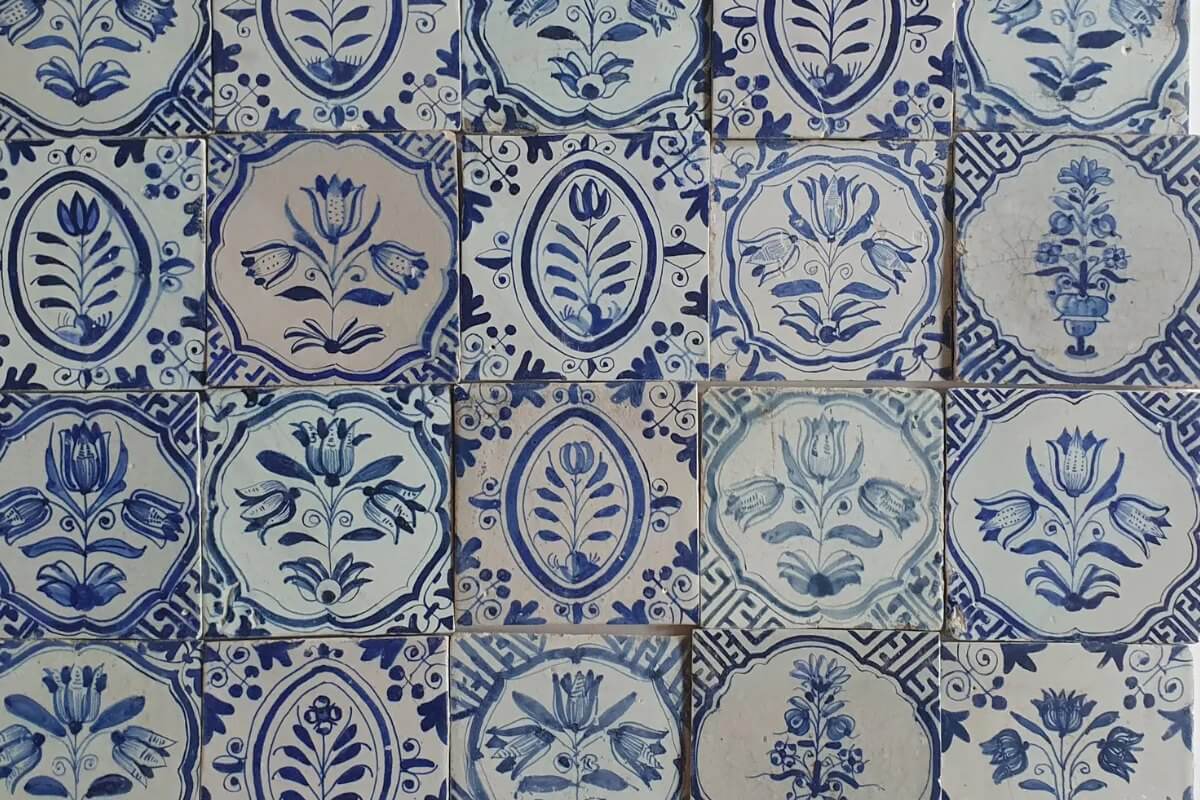
The tulip on antique Dutch tiles – symbol of stock market trading, wealth and the tulip mania leading to the first stock market crash
Summary
The tulip on antique Dutch tiles is more than a decorative motif. She represents a period when beauty, rarity and fair trade came together. From its origins in the Ottoman Empire and introduction to Europe around 1550, the tulip developed into a popular collector’s item in the Netherlands and later into a trade product during the tulip mania of around 1630-1637. During the same period, the tulip appears on Delft tiles. This blog traces its development from flower to symbol, and how this significance remains visible in the decorative tradition.
The origins of the tulip in the Ottoman Empire
The tulip originated in Central Asia and was refined cultivated in the Ottoman Empire. Within this culture, the flower had a special status. It was grown in palace gardens and stood for order, beauty and refinement.
Through diplomatic contacts, the tulip reached Europe around the middle of the 16th century, about 1550-1560. From the Ottoman court, bulbs are taken to Vienna, among other places, where the first European cultivation arises.
The flower is immediately striking because of its shape and color. It differs markedly from known European plants and therefore quickly gains the attention of collectors and botanists.
Introduction and cultivation in the Netherlands
At the end of the 16th century, the tulip became established in the Netherlands. Around 1593, Carolus Clusius began growing tulips in Leiden in the Hortus Botanicus.
From then on, a growing interest develops. Tulips are collected, compared and grown. Especially varieties with flamed patterns attract attention and are considered special.
At this stage the emphasis is on appreciation and rarity. The tulip is not yet a commodity, but an object of interest and admiration.
From hobby to trade
In the first decades of the 17th century, the role of the tulip shifts. What begins as an interest grows into trade. Tulip bulbs are bought and sold, first within small circles and later on a larger scale.
Value is determined not only by the flower itself, but also by demand and availability. This creates a market in which prices can move based on expectation.
Increasingly, agreements are made about future delivery. This gives trade an abstract character: it is not only about what is, but also about what may come.
Tulip mania and stock market trading
Between about 1630 and 1637, this development reaches a peak. The trade in tulip bulbs grows rapidly and attracts more and more participants.
The market takes on characteristics of exchange trading. Contracts are traded on the basis of future delivery. The value of a tulip bulb thus becomes a matter of expectation.
During this period, exceptional specimens traded for amounts comparable to the price of a good house. These are exceptional cases, but they show how strongly the value could rise.
The tulip at this stage becomes a symbol of wealth and economic activity. Not only as a flower, but as a carrier of value.
The stock market crash of 1637 and the loss of confidence
In early 1637, this development comes to an end. During a moment of sale, it appears that buyers are no longer willing to pay the agreed prices. Trade slows and then quickly comes to a halt.
Because many transactions are based on contracts, tension arises immediately. Agreements are not kept and lose their value. What was previously seen as security turns out to depend on trust.
Prices fall in a short period of time. Expected profits disappear and contracts prove difficult to settle. Uncertainty arises within trading circles.
The impact is mostly limited to the traders involved. The broader economy continues to function, but the event shows how fragile a market can be when value is largely based on expectation.
Local governments are looking for ways to stabilize the situation. In many cases, contracts are adjusted or bought off at lower amounts so that parties can move forward.
The tulip mania thus becomes an early example of a market in which price and reality temporarily diverge.
The tulip within the decorative and symbolic tradition
During the same period when the tulip is traded, it also appears in art and decoration. The flower becomes part of a broader visual culture.
On antique Dutch tiles, the tulip appears early in the 17th century. This occurs simultaneously with the rise of commerce. The tile thus directly reflects the world of the time.
The tulip is rendered stylized. The shape is reduced to a clear and recognizable image that fits within the square plane. This creates peace and cohesion when tiles are combined.
The meaning of the tulip is layered. It refers to beauty and appreciation, but also to trade and expectation. This combination gives the motif its power.
Tulips on Delft tiles
On Delft tiles, the tulip is often placed centrally. The composition is balanced and focused on simplicity. The flower forms a quiet centerpiece.
A well-known example is the Hoorn tulip, executed as a double tile set. Two tiles together form one representation. This shows how the motif can be part of a larger whole.
Tulips are used on individual tiles as well as in larger wall areas and fireplaces. The repetition creates a calm and cohesive image.
The tulip tile as an expression of wealth and status
The tulip on a Delft tile is not only a decorative motif, but also a deliberate choice. In the 17th century, tiles were not neutral wall coverings. They were part of the interior and contributed to the appearance of a room.
Homes of wealthy citizens, merchants and regents often featured tile walls in kitchens, hallways and fireplaces. Within these applications, the choice of motif played a role. A tulip tile referred not only to a beloved flower, but also to a world of commerce, value and refinement.
Especially during the period when the tulip played a role in stock market trading, the motif took on added significance. Depicting a tulip could be seen as a reference to knowledge of the market, involvement in trade or appreciation for what was rare and sought after.
Tiles with tulip motifs were bought by people who were aware of this significance. These were not only direct traders in tulip bulbs, but also citizens who were part of a broader trading culture. The tulip represented a way of thinking in which value, expectation and possession came together.
Within an interior, the tulip tile functioned as a quiet but recognizable sign of this world. Not emphatic or showy, but naturally present. The repetition of the motif in a wall or fireplace reinforced this effect. What appears modest on one tile takes on a distinct appearance in a larger whole.
In addition, the tulip dovetailed with other motifs used during the same period. Together with representations of ships, landscapes and animals, they formed an image of a society in which trade and international contacts were central.
The choice of a tulip tile was thus not merely aesthetic. It showed that one was part of a culture in which trade, knowledge and refinement came together. Precisely because this meaning was not made explicit, but was enclosed in the image itself, its power remains recognizable to this day.
The relationship to the world of the VOC
The rise of the tulip coincides with the heyday of the VOC. Trade and international contacts play a major role in Dutch society.
The tulip itself is the result of this exchange. Through trade routes and diplomacy, it reached Europe and eventually the Netherlands.
On Delft tiles we see this world reflected in various motifs. The tulip fits within this as a symbol of what came to Holland through trade.
You can read more about this in the blog on VOC and Delft tiles.
From trade object to enduring motive
After the tulip mania, the tulip does not disappear. The flower remains present in art and decoration. Its meaning changes, but its form remains recognizable.
On antique tiles, this transition becomes visible. The tulip is detached from its role as an object of trade and given a permanent place as a sculpture.
It still refers to wealth and commerce, but mostly becomes part of the decorative tradition.
The tulip within the world of Delft tiles
Tulips join other motifs from the same period, such as landscapes, animals and maritime scenes. Together they form an image of the 17th century.
For more background see also the blogs on The history of Delft tiles, VOC and Delft tiles and Processing antique Delft tiles.
Tulip tiles today – a lasting symbol in interior design
The attraction of the tulip on antique Dutch tiles has not disappeared over time. On the contrary, it is precisely the combination of history, form and meaning that still makes these tiles special.
A tulip tile brings a piece of the 17th century into the interior. Not as a striking statement, but as a calm and recognizable image with a layered background. The reference to trade, value and refinement remains present without being foregrounded.
We offer antique tulip tiles carefully selected for quality, appearance and origin. These tiles can be used separately or incorporated into a wall or fireplace. In addition, it is possible to frame a tile, making it stand out as an independent object as well.
It is precisely in a framed form that the tulip tile takes on a new function. It becomes an object that fits into an interior where attention is paid to detail, history and meaning. As such, it also forms a fitting gift.
In spaces where commerce, finance or decision-making are central – such as an office, study or reception area – the symbolism of the tulip connects naturally. The tile references a time when value, expectation and insight came together, and retains that meaning in a contemporary context.
Conclusion
The tulip on antique Dutch tiles connects different worlds. It begins as a flower from the Ottoman Empire, develops into a collector’s item and becomes a symbol of stock market trade during the tulip mania.
On Delft tiles, this history remains visible in a quiet, stylized form. The tulip refers to wealth, trade and expectation, but retains its value as an image.
It is precisely this combination that makes her one of the most significant motifs within the Dutch tile tradition.