

The man with the fly whisk looks at us thoughtfully. According to the caption, we see Lü Xian, the immortal Lü—whose real name is Lü Dongbin—born in the year 796. He is one of the eight immortals of the Taoist tradition, depicted with a magical sword slung across his back. Obviously a tile from China, you might think.
However, this tile was not painted in China, but in Makkum, at the Tichelaar pottery factory. It is one of dozens of tiles featuring different designs, a series made possible by the Martin van Straaten trading firm. The founder and namesake—an oil merchant with both British and Dutch citizenship—also had a keen interest in arts and crafts and, in the late 19th century, focused his business on the tile trade, among other things.
He became one of the clients of the last Dutch tile factories that still produced traditional, handmade tiles with tin glaze. In England, where large-scale industrial production had begun early on, a niche market remained for this artisanal product, in keeping with the ideals of the Arts and Crafts movement. In 1915, Van Straaten perished on his return journey from New York as a passenger on the Lusitania, which was sunk by a German submarine with more than 1,200 people on board.
The firm was continued by his business partner and son-in-law Charles Lam, who placed a new series of orders in the Netherlands shortly after the end of World War I. Among other things, he asked Tichelaar in Makkum for a series of large tiles with exotic “Persian” designs, which today we would more likely call Ottoman or Iznik.
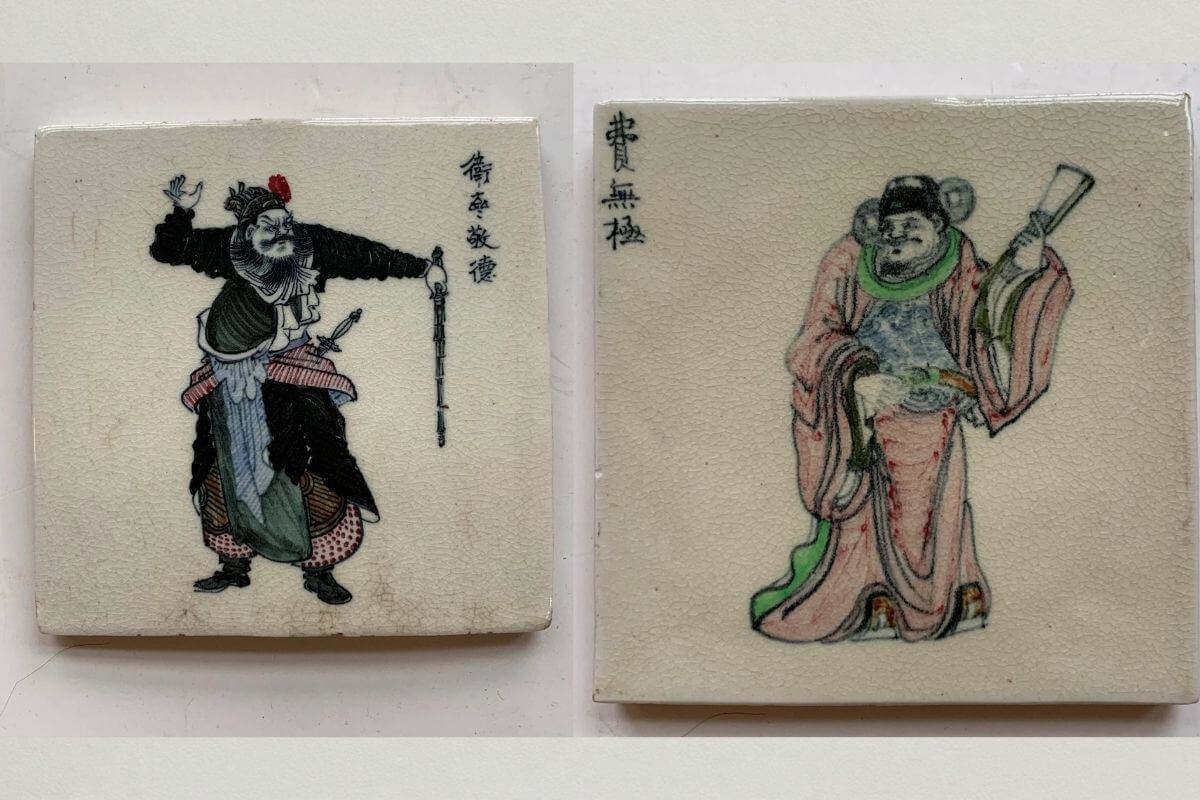
But he also had contacts in China, with the tile maker Wu Jinhe, in the Fengxi district (in Chaozhou Prefecture, Guangdong Province). It is possible that as early as 1910, he was already supplying porcelain tiles depicting a variety of historical figures and characters. Some of these were drawn from classical Chinese literature, such as the 14th-century *Romance of the Three Kingdoms*. Hundreds of different depictions of him have been documented. It was a product for a luxury market; the tiles would find their way into homes on Downing Street and Primrose Hill, as well as into the Harrods department store—though there, they were used in the staff restrooms.
In the summer of 1927, a major civil war broke out in China. As a result, the supply of tiles virtually came to a standstill. Charles Lam once again approached the firm Gebroeders Tichelaar, this time asking if they saw an opportunity to produce a similar product. He sent a series of 55 porcelain tiles to Makkum, and in early 1929, he sent another set of watercolors to provide a better indication of the desired colors. However, some experimentation was necessary; the tin-glaze technique is less suited to the sharp drawings that are possible on porcelain. A so-called “strict glaze” was applied, which runs less.
And they took the task extremely seriously. Especially on the tiles from the 1930s, the Chinese characters were copied so carefully that the names are still legible to anyone who can read the script.
AusemaEU
+31 (0) 6 37 40 73 92
www.houseofausema.com
In addition to 17th-century tiles, AusemaEU has a large collection of 20th-century Chinese tiles. A portion of this collection was on display in 2021 at the Dutch Tile Museum in Otterlo as part of the exhibition “Chinese Tiles from Makkum.” The collection is also discussed in the publication by Jan Pluis and Min Chen: *20th-Century Dutch Tiles with Chinese and Japanese Motifs*, Leiden 2020.